The Hidden Switch: AI Just Started Reading the Grammar of Life
We used to think the genome was a book. Now we're learning it's more like a control room — and for the first time, an AI has started reading the manual.
For decades, science focused on which genes exist in human DNA. The harder question was always the one underneath: what decides when a gene switches on, in which cell, and how strongly? That hidden layer of control — the regulatory machinery — is where life actually makes its decisions.
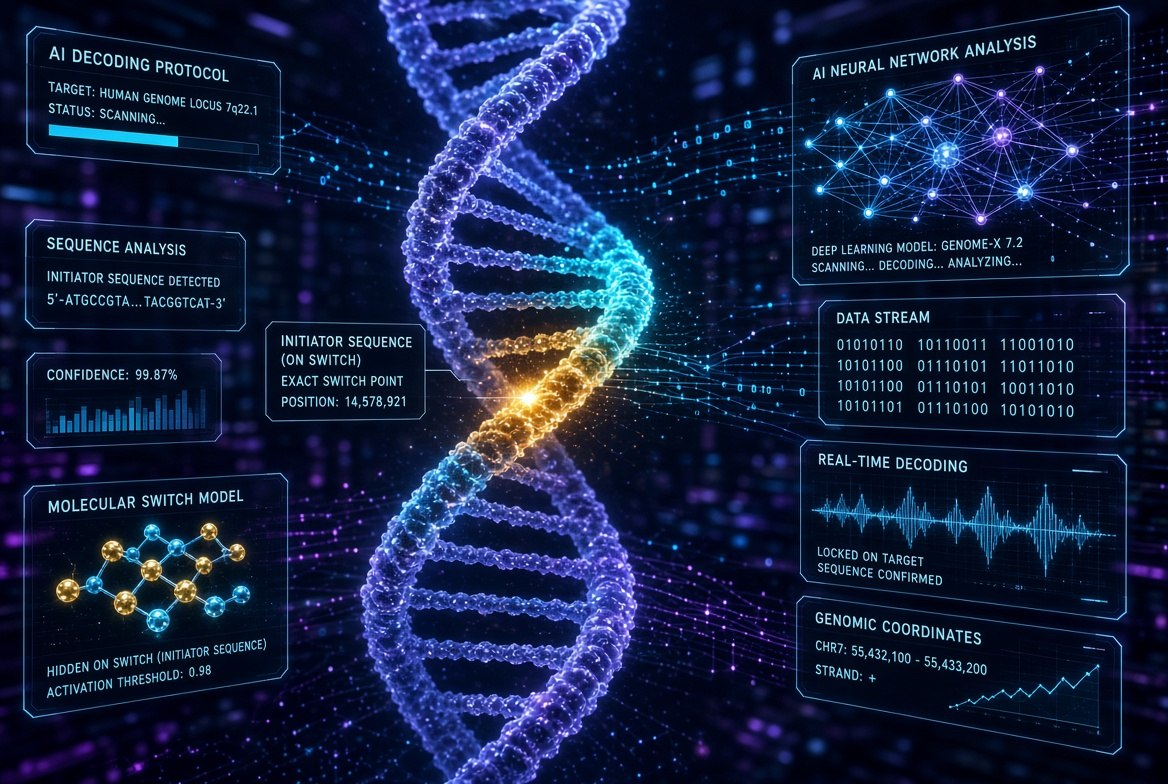
A new study from the University of California San Diego shows AI is beginning to crack it. The team behind researcher James T. Kadonaga focused on the initiator (Inr), a small element in core promoters that marks exactly where a gene's transcription begins. It's been called a "hidden switch" because its sequence varies so much that it resisted full definition for years.
To decode it, the lab generated and measured the expression activity of roughly 500,000 different versions of the initiator region using high-throughput DNA sequencing. With that data, they trained machine learning models — specifically support vector regression — that learned the characteristic base pattern of the initiator. When the model scanned human genes, it found the motif in about 60% of them — a higher share than earlier estimates suggested.
Don't mistake this for some mysterious button that turns on the whole genome. It's one specific, important piece of a much larger regulatory system. But it's a genuinely useful piece: the model can predict whether a mutation in the initiator region will disrupt a gene's activation — which matters for understanding cell dysfunction and diseases including cancer.
And there's a second, bigger horizon. The same data can help design synthetic promoters: artificial sequences engineered to turn genes on or off in precise ways. That opens a field that will need not just scientific progress but a serious conversation about limits and applications.
Maybe the most interesting part isn't the biology at all — it's the method. Labs produce enormous datasets; AI finds the patterns humans struggle to see. Extend the same approach to more regulatory elements, and we gradually assemble a map of the grammar that controls the human genome.
Then the question becomes much larger than another AI application: what happens when we can not only read genes, but accurately predict how the cell itself decides which ones to use?
Sources: University of California San Diego / ScienceDaily, Aug 23 2026. Torrey E. Rhyne-Carrigg et al., "Machine learning analysis of the human initiator region reveals key features of different types of core promoters," Genes & Development, 2026.
— The Angle, by Raw Feed News