Trump says he 'loves the inflation' as US prices rise at fastest rate in three years
11 minutes ago
Archie MitchellBusiness reporter
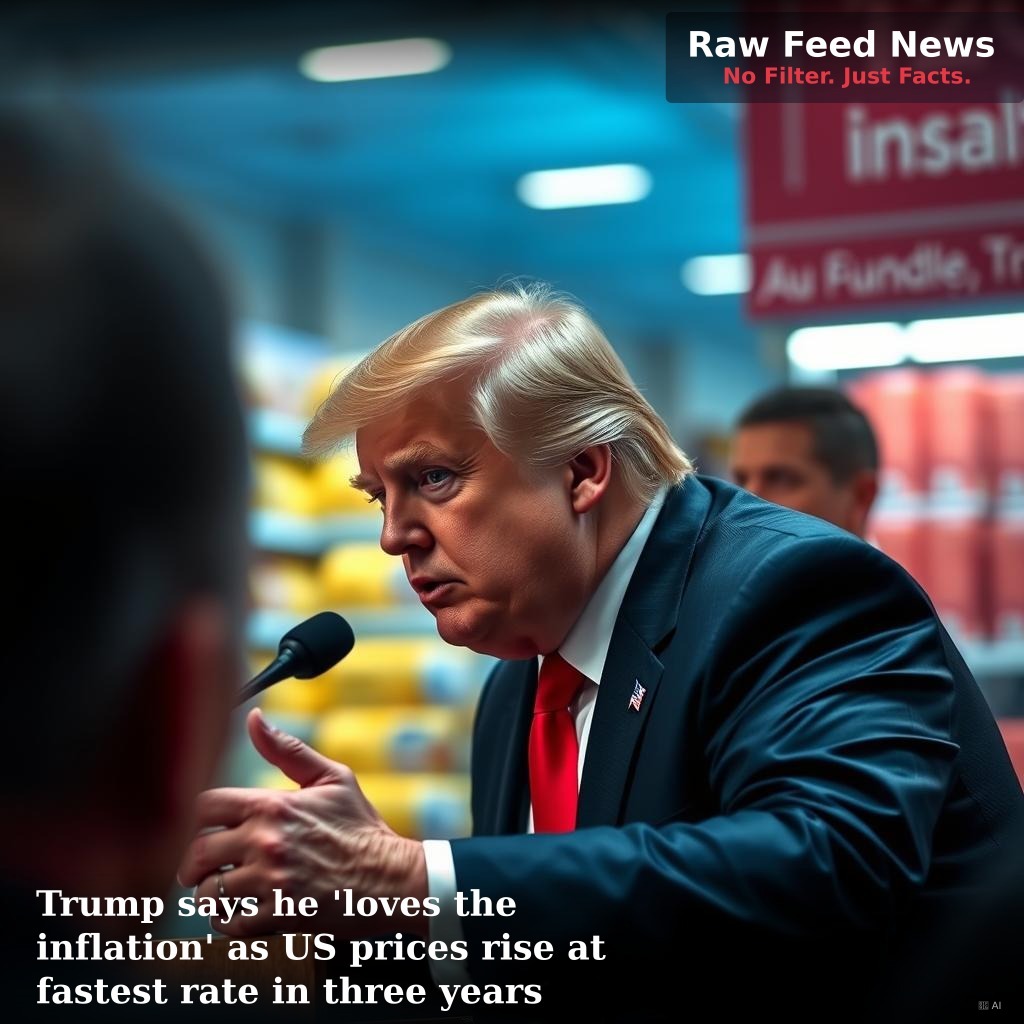
President Donald Trump has said he "loves the inflation" as US prices rose last month at their fastest rate in three years.
Bureau of Labor Statistics (BLS) figures showed prices went up by 4.2% in May from a year earlier. The increase, from 3.8% in April, was driven by rising energy costs in the wake of the US-Israel war in Iran.
Speaking at the White House, Trump said: "I love it. The numbers were great. You know what I really love? I love the inflation."
But he promised the rising prices would "come down like a rock" when the war with Iran was over. Later in the day, the US military bombed Iran.
Reacting to the inflation, the president said US forces had conducted nighttime operations in which tens of ships had removed millions of barrels of oil from Iran, contributing to a slight drop in oil prices.
"When this conflict is over… you will see oil drop to where it was before," he told reporters in the White House.
The president pointed to a trip to Iowa in early 2026, saying he saw petrol selling for $1.85 per gallon, adding that "we will be back at those levels very soon".
The global benchmark for oil, Brent crude, is still trading significantly higher than pre-war levels.
Wednesday marked the third month in a row the US Consumer Price Index (CPI) has risen, with households increasingly feeling the strain of the US and Israel's war in Iran.
Trump has previously said that inflation is only heating up temporarily, and he expects it to rapidly cool once the war ends. Inflation is still far below its peak of 9.1% under his predecessor Joe Biden in mid-2022.
Still, it poses a political problem for Trump, given that voters have ranked the economy as a top concern ahead of November's midterm elections.
Higher inflation raises the likelihood of the US Federal Reserve raising interest rates in a bid to curtail spending.
Overall energy bills including gas and electricity were almost a quarter higher in May than a year earlier, with petrol responsible for much of the increase.
According to separate figures from motoring group the AAA, the average price of a gallon of regular petrol in the US is currently $4.15, a sharp increase from $2.98 on February 28, when Trump launched strikes on Iran.
In response to the strikes, Iran has effectively shuttered the crucial Strait of Hormuz waterway, which typically ships around a fifth of the world's oil and gas, choking supply.
Elsewhere, the BLS pointed to the increasing cost of plane tickets, personal and medical care, recreation and communication.
The CPI is a measure of how much prices have risen in a given month compared to the same month a year prior. The Fed's long-term inflation target is 2%.
May's inflation increase captures the challenge facing President Trump and the Republicans ahead of November's midterm elections.
Economists have warned that, even with a swift resolution to the war, it could take until 2027 for the normal flow of goods through the Strait of Hormuz to be restored.
It raises the prospect of Americans heading to the polls under the strain of significantly higher prices, following a 2024 campaign in which Trump promised cutting inflation would be at the heart of his agenda.
Trump previously said he did not think about the cost of living issue facing Americans "even a little bit" in the context of the war, stressing "we can not let Iran have a nuclear weapon, that's all".
Higher inflation also poses a challenge for Kevin Warsh, the new governor of the Fed, ahead of his first interest rate decision in charge of the central bank next week.
When inflation is significantly above the Fed's target rate, the central bank's board of governors typically moves to raise interest rates. This in turn pushes up borrowing costs and restricts the flow of money in the economy, limiting further price hikes and bringing inflation under control.
In the run up to Warsh's appointment, Trump repeatedly called on his predecessor, Jerome Powell, and the central bank to cut interest rates.
Economists expect rates to remain at their current level, between 3.5% and 3.75%, next month, but warned further evidence of inflation persisting could force the Fed into a rate increase.
Stephen Brown, chief North America economist at Capital Economics, said May's rise alone was "not large enough to prove any ammo" to those on the Fed's rate-setting committee who want to push interest rates up.
But Isaac Stell, investment manager at asset manager Wealth Club, said an interest rate hike is "the most logical conclusion from today's data combined with last week's healthy jobs numbers".