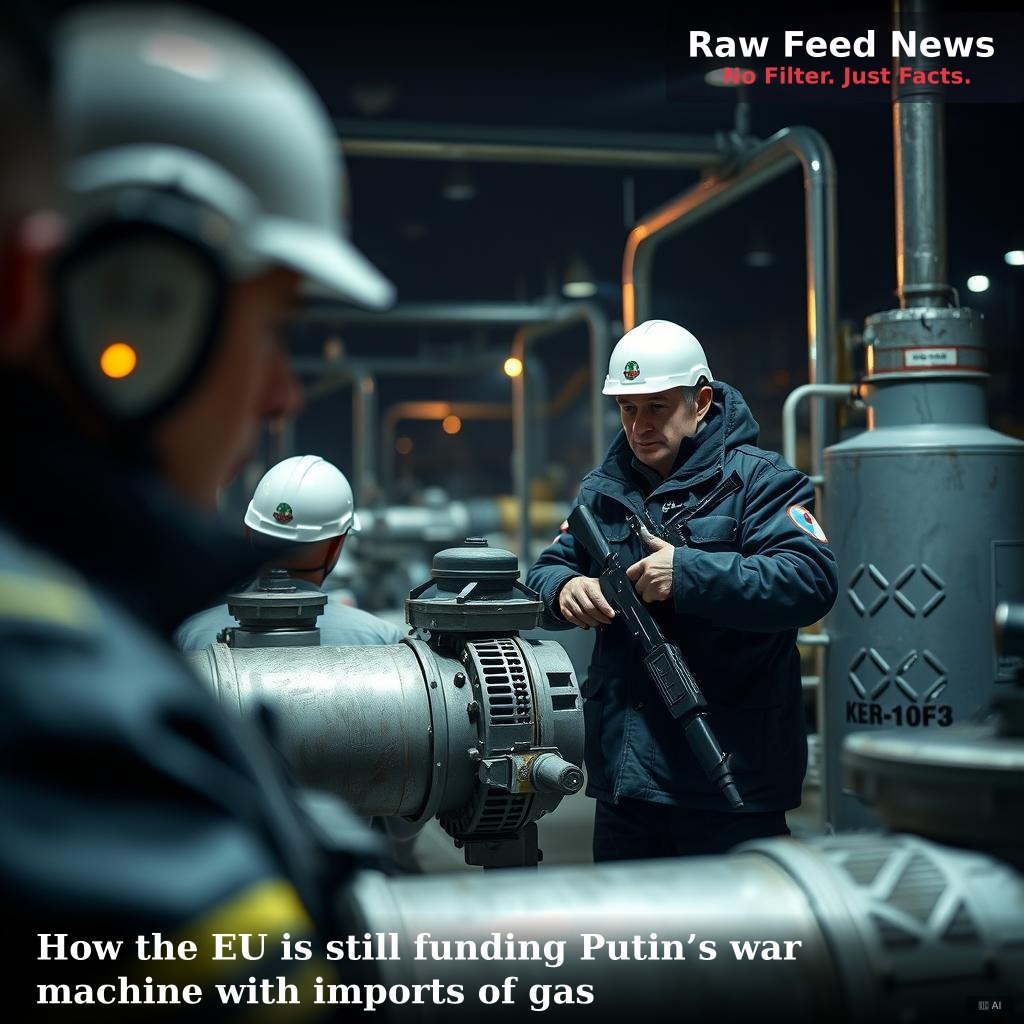
How the EU is still funding Putin’s war machine with imports of gas
EU imports of Russian liquefied natural gas (LNG) have increased, helping keep Moscow’s wartime economy afloat as Ukrainian strikes on energy infrastructure and European sanctions deal heavy blows.
Between January and May 2026, 8.37 million tonnes of Yamal LNG, a strategically important oil project in northwest Siberia, were delivered to EU ports, marking a 17.9 per cent increase compared to the same period in 2025, according to data from Kpler analysed by environmental NGO Urgewald.
This means European countries received 96.7 per cent of all Yamal exports in the first five months of 2026, with bans on short-term LNG contracts yet to take full effect, while bans on long-term contracts are not set to come into place until next year.
With Moscow’s economy flagging under the weight of damaging EU sanctions and Kyiv scaling up attacks on Russian oil facilities, experts say the failure to implement stricter measures on LNG is a wasted opportunity and demonstrates to Vladimir Putin that the Europeans “really don't have the stomach to turn the screw fully”.
“LNG sales of course are helpful, and seen in the context of what Russia is doing in terms of prosecuting this war, it's disappointing that European countries are still effectively contributing to the Russian budget,” said John Lough, head of international at the New Eurasian Strategies Centre.
EU bans yet to take effect
In May 2026, 23 out of 25 Yamal LNG cargo ships arrived at EU ports, totalling 92 per cent of Yamal exports - a more-than 20 per cent increase from May 2025.
This comes despite the EU’s stated aim to phase out all Russian fossil fuels and fresh restrictions imposed on short-term Russian LNG contracts.
Short-term contracts signed before 17 June 2025 were banned as of April this year, while any new Russian import contracts were banned as of 18 March 2026. This, however, leaves a nine-month gap for short-term contracts concluded between these two dates, all of which remain valid - meaning the measures are yet to have an impact on Yamal LNG flows to Europe.
Long-term bans on Russian LNG will not be banned until 2027 onwards, a move which was agreed last year.
“I don't think that in the next couple of months we'll see a lot of change [in LNG imports] because Russia doesn't really have any alternatives, and Europe still has the appetite for Russian gas,” said Sebastian Rötters, sanctions campaigner at Urgewald.
The closure of the Strait of Hormuz, he added, may also be hindering efforts to reduce reliance on Russian LNG, motivating buyers in long-term contracts to “try to get in as much volume as they can” before the ban.
‘The symbolism is more damaging than the Russian financial gains’
LNG exports, while helpful for the Russian economy, are not a source of revenue which it is wholly dependent on.
The symbolism of the failure to implement an effective and hefty ban on LNG exports could be just as damaging as the actual fuel it provides to Moscow’s economy, Mr Lough said.
The failure of the bans demonstrates to Moscow that Europeans don’t ‘have the stomach to turn the screw fully’ (AFP/Getty)
“We're talking about volumes of revenue that, of course, are useful to the Russian state, but they're not, it seems to me, of critical importance,” he said, adding: “There’s not this sort of cash crunch that many people thought there would be when these draconian sanctions were imposed, because Russia is still able to sell oil and gas to the Asian markets”.
But the symbolism of failing to entirely cut out LNG exports “suggests to Moscow that Europeans really don't have the stomach to turn the screw fully, and for the Ukrainians, it suggests much the same, Europe’s not 100 per cent behind us, that's what they go away thinking”, Mr Lough said.
Moscow can demonstrate that Europe “doesn’t have the courage of its convictions, it talks a great game, but the reality is always different”.
Does the bigger picture tell a different story?
Mr Lough adds that Europe should nonetheless be recognised for doing “a great deal”, with the overall change since the war began in February 2022 “nothing short of dramatic”.
Volodymyr Zelensky himself has adopted a similar tone, at the same time thanking Europe for some of the dramatic action it has taken, while still warning that it was not going far enough.
The Ukrainian president has consistently called on Europe to reduce its dependency on Russia. Kyiv itself has moved to secure large supplies of US-origin LNG to replace domestic production and Russian gas flows.
But Mr Lough says the bigger picture shows sanctions and reduced dependency have severely damaged the Russian economy for decades to come.
“Sometimes, when you're following this on a day-to-day basis, you're looking for these minor differences the whole time, but we do have to stand back and look at the overall canvas, because this is devastating for Russia,” he said.
“It's going to take decades to rebuild these economic relationships, if they are even salvageable at all. Maybe in 30 years' time the demand globally for oil from Europe is going to be much less.”