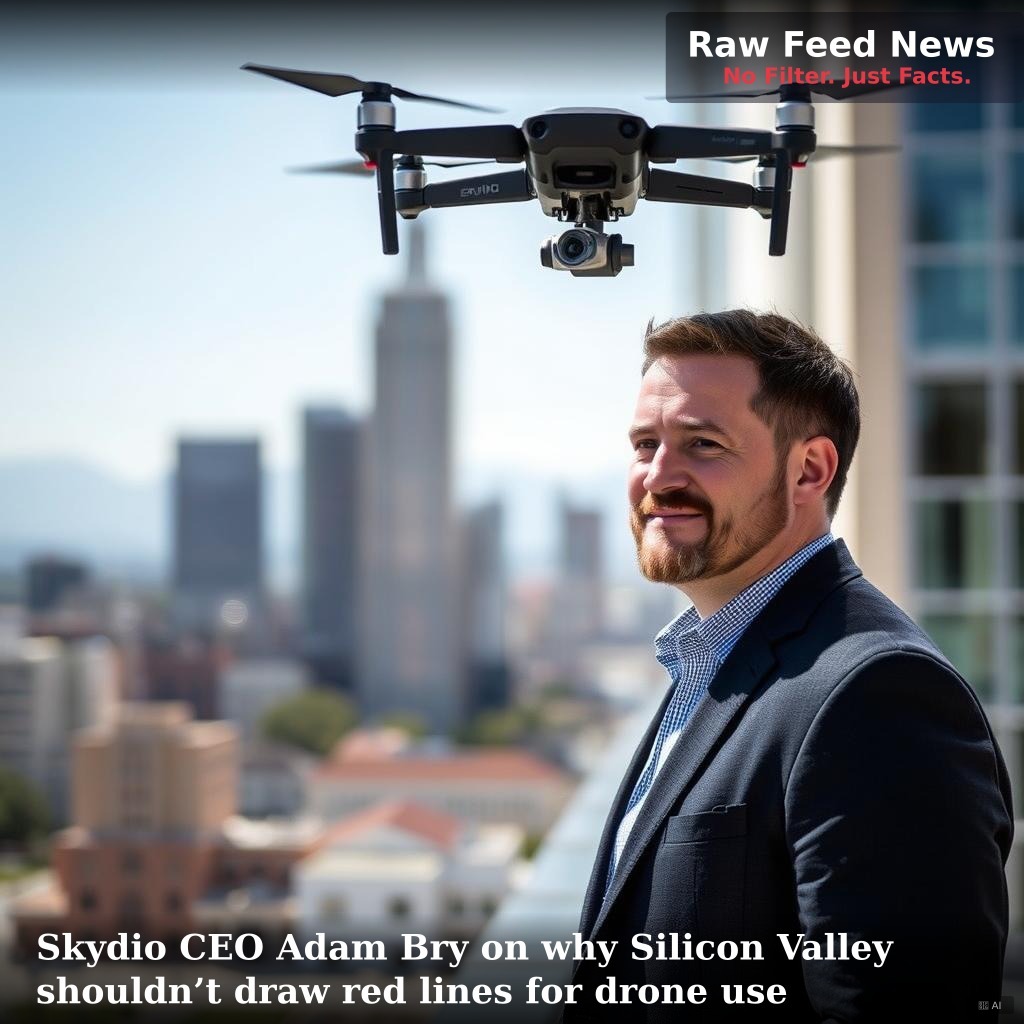
Skydio CEO Adam Bry on why Silicon Valley shouldn’t draw red lines for drone use
Today, I’m talking with Adam Bry, who is CEO of Skydio, the leading US maker of autonomous drones. Before we recorded this episode, I actually got to remotely operate one of Skydio’s drones in the Bay Area from Adam’s laptop in our podcast studio in New York and fly an indoor drone around our office. You can check out the full video of that on our YouTube channel.
Beyond flying drones around the country, Adam and I talked about why Skydio is so focused on the enterprise market — I asked him a lot about working with police and military, but you’ll hear him say a lot of Skydio’s customers are utility companies that use drones to remotely inspect important infrastructure in ways that weren’t possible before.
Verge subscribers, don’t forget you get exclusive access to ad-free Decoder wherever you get your podcasts. Head here. Not a subscriber? You can sign up here.
That’s a big market, but it’s also one that was being served by cheap consumer drones in the past — products that basically no longer exist on the US market since most of them came from China, and the Trump administration banned foreign-made drones late last year. All those inexpensive DJI drones disappeared overnight, leaving expensive Skydio products as the main alternative.
Adam and I talked about all that and the reality of manufacturing complex products like drones in the United States. We also talked about Skydio’s work with the military and how Skydio’s use of AI lines up with defense work — I really wanted to know where Adam’s lines were, at a time when military use of AI is more controversial than ever.
There’s a lot in this one — maybe more than anything, it was refreshing to hear Adam talk about using AI to bring even more people to work at Skydio as the company expands. And again, I got to fly the drones, which ruled.
Okay: Adam Bry, CEO of Skydio. Here we go.
This interview has been lightly edited for length and clarity.
Adam Bry, you are the co-founder and CEO of Skydio. Welcome to Decoder.
I’m very excited to be here with you.
I am super excited to talk with you. We just demoed flying an X10 drone remotely. I have a lot of follow-up questions about that. That was super interesting.
I would say the drone business itself is in a moment of extreme change. There are policies keeping some of your competitors out of the country. There’s what you’re doing with autonomy and working with governments and militaries around the world. Then, there’s just the state of drone technology in general, which seems like it’s on the cusp of being yet another thing. So, there’s quite a lot to talk about.
Let’s just start with the basics. Unless you’re a drone nerd, you might not have heard of Skydio. Explain what Skydio is and how the company came to be.
We are the largest US drone manufacturer. We make drones that are essentially flying sensor platforms. We started in 2014, and at this point, we serve what we think of as the critical industries our civilization depends on. We work with public safety. We work with militaries. We also work with energy utilities, construction companies, departments of transportation, and security organizations.
The common thread between all of our customers is that they have hardcore, oftentimes high-risk physical operations, where putting sensors in the right place at the right time to get better information can fundamentally change outcomes. That’s what we deliver. We deliver end-to-end solutions where the drone is a key piece, but the software, autonomy, integrations, and, increasingly, the end-to-end workflows for the different industries built around the drone’s capabilities are really what our customers are buying.
We’re at a super exciting moment where after years of talking about a lot of this stuff, it’s really starting to work at scale with incredible impact.
If I think about just our drone coverage over the years, it started with those first DJI drones almost 10 or 15 years ago now. The first Phantom drones were pretty rickety. They had these giant batteries. And it was really just about flight, and being able to control flight in an easy-to-use way. Then we very quickly got to, “Oh boy, we could put fancy cameras in the sky,” and that was really fun. And those cameras got really fancy. Now you’re saying it’s a whole sensor suite, or is it just augmented cameras?
I actually think what you described there closely parallels the chapters of the drone industry that I think about. In the very early days, these electric flying machines were really toys. I think of the first chapter, and the first 10 years was about the electrification of radio-controlled airplanes, which were recreational. It was fun to go out and fly. This is the world that I come from. I grew up flying radio-controlled airplanes.
What I think happened is that people started bringing the toys to work and realizing that if you put the right camera on there and you had a skilled pilot flying it, you could do a lot of useful stuff. That created cool videos that showed up in cinematography, commercial real estate, things like this.
The next chapter is about autonomy, where the drone lives in a docking station, is connected to the internet, can be flown remotely and autonomously, and is a piece of infrastructure itself. I think the impact that we’ll see from that is going to be orders of magnitude larger than everything we’ve seen thus far. And we’ve seen a lot of good stuff thus far. I mean, a lot of great work has happened in the world of drones as tools. It’s just very small scale compared to what’s coming, and we’re really at that transition moment now.
Describe the idea that flight is the fundamental building block, that you don’t need to think about it as much because you’re talking about the capabilities built on the second and third order of the thing able to fly itself. Do you spend time investing in how the drones fly themselves or is that solved?
We spend a ton of time investing in that. There’s kind of this trope in the drone industry where, “Oh, it’s not about the drone. It’s about the data.” Which is sort of true. You could say the same thing about almost anything. It’s not about the phone, it’s about the apps, the software, or whatever.
But you have to earn the right to deliver these solutions. The way you earn that right is by being a world-class designer and manufacturer of these systems and making them super capable and super reliable. I think one of the things that’s oftentimes missed with drones is the idea that they are cutting-edge aerospace devices. They vibrate, they have aerodynamics, they have thermal concerns. We have really advanced compute running on board, a bunch of sensors. It’s akin to building a self-driving car that flies.
If you want to be a good drone company, you need to be a world-class aerospace engineering organization across 10 or 15 different disciplines. It’s only once you have that and are great at it that you can then start to focus on enterprise software integrations that connect your solution into, for example, 911 dispatch software that a public safety organization might be using or the incident management system for an energy utility.
Those things really matter, but if the core technology foundation isn’t great, they’re less important.
We’re going to come back to the phrase “world-class.” I have a lot of questions about what it means to be world-class in our current regulatory and tariff environment, but give me some examples.
We have a consumer audience where probably everybody listening or watching has used one variant of a consumer drone. Just like every other product, they get slightly better every year until the fifth yearly model, which is a step change better than the model people might be familiar with. What are some of the big advancements in flight capability that people might not have perceived over time?
Originally, drones flew with raw stick to control service input. So, I grew up flying radio-controlled airplanes where you held a joystick transmitter. When you moved that joystick, a direct command was sent to either an electric motor or a servo motor that would move a control surface, which moved directly in response to what you did. There was no compute between your stick input and what happened on the device.
The next step after that — which is what made the quadcopter possible — is to take very low level, primitive microprocessors next to inertial measurement units (the thing in your phone that tells it what orientation it’s in) and write what’s called a pretty basic “attitude control loop.” That’s the fundamental thing running at the bottom of every quadcopter control stack. It basically tells it which orientation to hold in physical space. So, when you move the stick, it maps to the orientation of the quadcopter. Without that, a person couldn’t fly a quadcopter. There’s no way you could move the stick to give a raw motor command. Just the mapping would be too much for our brains. So, that was the beginning of those things becoming a bit more accessible.
The next step was the GPS position hold, of not just holding an altitude but using GPS to figure out your rough position and being able to hold a position in sky. That was a big step forward because that meant you could go hands off, and the drone would just sit there and hover. That was a necessary step to get beyond needing expert, pilot-level skills so they can be usable by anybody. That’s what most drones historically have done, and most drones today still operate mostly based on GPS.
I would say the next big chapter — and Skydio really helped pioneer this — is using computer vision, or putting cameras on the drone. Not just the camera that captures the video the user might care about but cameras that see everything. They can go into a computer that’s running onboard AI and use visual information to make intelligent decisions, like holdingposition even if you don’t have a good GPS signal, avoiding obstacles, or tracking moving subjects.
We started in 2014 and that was around the time... it seemed like a crazy idea, honestly. It’s hard to remember now but 12 years ago, using computer vision for anything outside of the lab seemed somewhat farfetched. We launched our first product in 2018, the Skydio R1, which I think was the first drone built around computer vision. Our competitors started doing similar things, and we’re now at a point where that stuff has reached maturity. I think there are still incredible capabilities yet to come, but it’s mature enough that you can count on it, rely on it, and build products around it. The fundamental thesis there was to build expert pilot skills into the drone, and I think the only way you can do that is by using computer vision.
I’m just so curious about the notion of this thing can fly itself and now we can build applications on top of that core capability. But it sounds like “this thing can fly itself” is not a finished project. That’s something you’re still spending a lot of time on.
Yeah, I don’t think it’s ever finished. There are just so many upsides here in what you can do, how good the automation can get, and what people can do with them. We work with public safety agencies today that are using these things to respond to 911 calls. Sometimes they need to follow a suspect — like somebody’s fleeing a crime scene in a car — and they’ll do incredible things while flying semi-manually.
Our autonomy system is still under the hood, but they’re flying semi-manually to track moving vehicles through urban canyons. Our AI system is very, very good. It’s not as good as the greatest human pilots I’ve seen fly in those scenarios yet, but it will be. And when it is, it’ll be that much more powerful and capable for more people to reap the benefits.
Yeah, I want to come back to that too.
I’m giving you a lot to come back to.
There are a lot of threads to pull on here!
I want to ask about Skydio itself. You’ve taken in a lot of investment recently. The company’s getting bigger. I think you’re up to Series F. You have a multi-billion dollar valuation. You’re about to make 2,000 more jobs here in the United States manufacturing drones. How many people work at Skydio today, and how’s the company structured?
We’re about 1,000 people, which I think for the scope and complexity that we manage is actually pretty tiny. We do a lot with a very, very small team because we have to span so many different disciplines: across engineering, software development, direct sales and customer support, and manufacturing. In many ways, I think the company’s kind of traditionally structured. We have a head of sales, a chief financial officer, a head of marketing, and a head of people operations. We could talk more about it, but I think people ops is one of the most important functions at the company.
What might be a bit unique is how technical we are at the senior levels. So, I have six or seven direct technical reports spanning hardware, software, hardware operations, and chief engineers for a number of the vehicle programs we’re working on. A lot of that is because I’m very technical. I have an engineering background. I still consider myself an engineer. I get pretty deep into the details sometimes on products and technologies that we’re working on.
It reflects our belief that these are cutting-edge aerospace devices, and if you want to be a great company in this space, you need to be world-class at engineering and delivering them. We spend a lot of time at the senior level deep in the technical weeds. My weekly staff meeting starts with a comprehensive review of every little technical thing that’s gone wrong with our products over the last week. We’ll go as deep as we need to in that meeting to figure out what’s going on and what we need to do about it.
We do the same thing with new programs, and we do that for a couple of reasons. I think it’s the most important thing. It’s not the only thing that matters, but it is the most important thing. I think it’s useful even for the people who are leading non-technical functions to get steeped and exposed to what’s happening technically and then vice versa. Having our engineering leaders well versed in the business, what’s happening financially, and what’s happening with our customers is super important because they’re making some of the most consequential decisions on the technical side, which are ultimately going to manifest in the market with our customers and in our financial results.
I get the feeling that you think a lot about the accountants taking over Boeing. That’s what that sounds like.
We’re like the antithesis of that. [Laughs]
Yeah. [Laughs]
I’m certainly familiar with that story. It sounds awful. It’s ultimately just us doing what we think is in the best interest of our customers, which is being really focused on having excellent products and technology, not just today but a year, two, five, or 10 years from now.
I think you are t