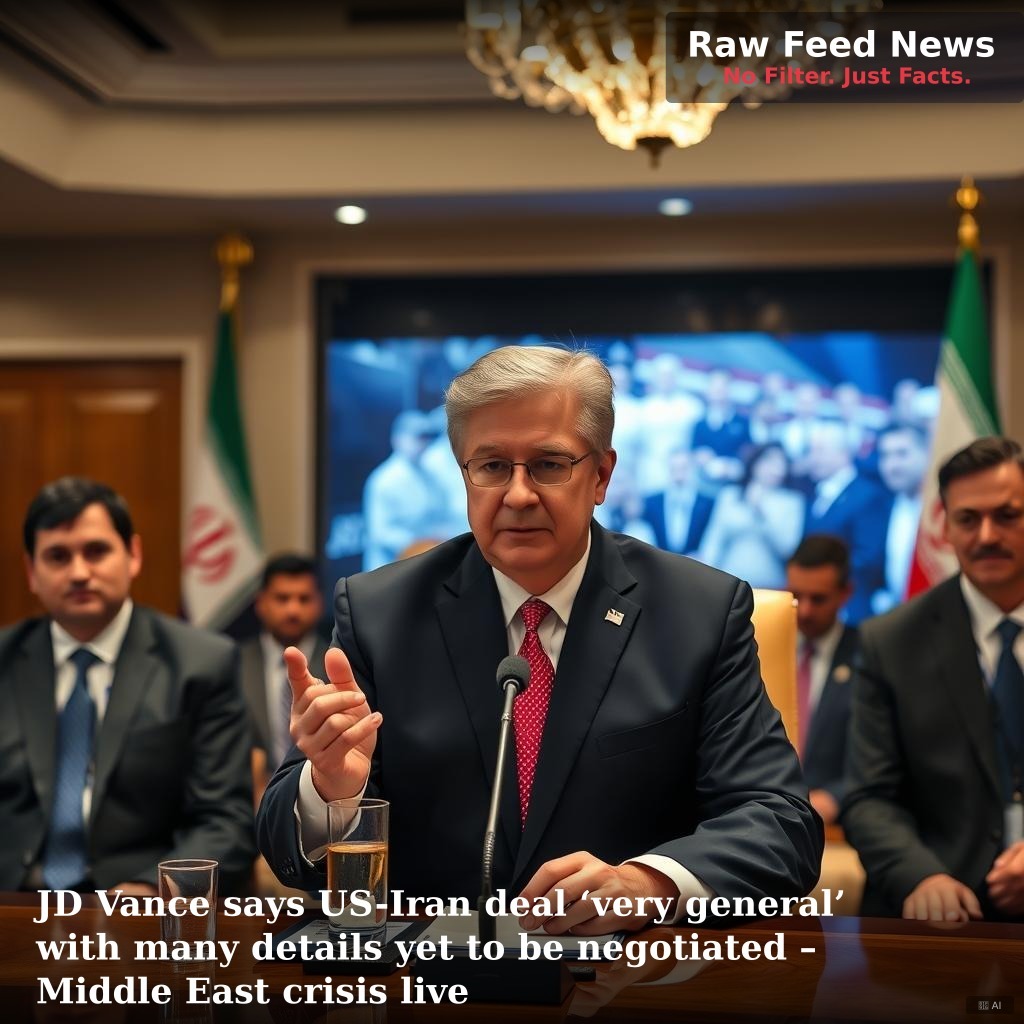
JD Vance says US-Iran deal ‘very general’ with many details yet to be negotiated – Middle East crisis live
Iranian foreign minister says ending Israel's war on Lebanon 'most important issue' in US deal
Speaking to diplomats in Tehran, Iran’s foreign minister, Abbas Araghchi, warned that any Israeli attack on Lebanon or continued presence on the country’s territory constituted a violation of the agreement with the US.
“The important point I want to emphasise here is that in our view, there are two parties to this memorandum – one side is America and Israel, and the other side is Iran and Hezbollah, ” Araghchi said.
“This is perhaps the most important issue in the memorandum – the declaration of an immediate and permanent end to the war on all fronts, including in Lebanon, ” he said, as he confirmed that Tehran and Washington will start a new round of negotiations on Friday in Switzerland.
This is scheduled to happen after the memorandum of understanding is signed in Geneva at a ceremony attended by the US vice-president, JD Vance, and the chief Iranian negotiator, Mohammad-Bagher Ghalibaf.
Even though the intensity of Israeli strikes on Lebanon has decreased since the announcement of the framework US-Iran deal, analysts say it is very unlikely they will stop altogether.
Israeli prime minister, Benjamin Netanyahu, said Israel would not leave the territory it was occupying in Lebanon despite the ceasefire agreement and has insisted on the right to protect northern Israeli communities from Hezbollah’s rockets and drones.
Israel says it is targeting Hezbollah assets and fighters but regularly kills civilians and destroys civilian infrastructure in broad attacks across southern Lebanon which have been carried out with effective impunity. But since Iran tied Lebanon to its negotiations with the US, Netanyahu, who is reliant on Washington for military and diplomatic support, has been forced to listen to Trump, at least somewhat.
Hezbollah, meanwhile, credited Iran with a “major achievement” in reaching the agreement, which it said could lead to “the full liberation of our land” and the “return of our prisoners to their homeland and families”.
Along with praising the deal, the Iranian-backed Lebanese militant group said it was committed to resisting Israel “until full withdrawal is achieved”.
Iran and Hezbollah, ” Araghchi said.", ], }">
Iranian foreign minister says ending Israel's war on Lebanon 'most important issue' in US deal JD Vance admits US-Iran memorandum of understanding is a 'very general document'
Gaza’s health ministry said in its latest update that at least five people were killed and eight others injured in Israeli attacks across the territory over the past day.
The health ministry says 997 people have been killed in Israeli attacks since the ‘ceasefire’ between Israel and Hamas came into effect in October 2025.
It says that 73, 008 people, many of whom were women and children, have been killed in Israeli attacks across Gaza since October 2023, when Israel launched its assault on the territory following the Hamas-led attack on southern Israel on 7 October 2023, in which about 1, 200 people were killed and 251 taken hostage.
The Guardian’s international security correspondent, Jason Burke, has written an interesting piece of analysis about how the interim US-Iran deal doesn’t address any of the region’s deeper issues, leaving analysts predicting instability and war could soon return. Here is an extract from his article:
double quotation mark
The interim deal now agreed does little more than commit both sides to further talks, while obliging Washington to lift its naval blockade of Iran and making Tehran allow free passage to all shipping in the strait of Hormuz, which usually carries a fifth of the world’s oil and liquid gas supplies but was blocked by Iran early in the war.
To the great displeasure of Israel, a ceasefire has been imposed once again in Lebanon as part of the interim deal and appears for the moment to be holding.
But such ceasefires count for little these days, said several experts, pointing to Gaza as an example, where almost 1, 000 Palestinians have been killed since Donald Trump brokered an end to the war there last year. Israel has occupied more than 60% of the territory, Hamas has not given up its weapons, and there has been almost no progress towards a projected second phase of the deal, let alone the third, which was to have brought a massive reconstruction effort.
“Gaza is a case in point. The deal there didn’t contend with the past: the war crimes that had been committed. Nor the present: how to disarm Hamas. Nor the future: a pathway to a viable Palestinian state and a resolution of the conflict, ” said Alia Brahimi at the Atlantic Council in Washington. “It’s almost as if … you can use the cover of a ceasefire to continue to achieve your aims, including military ones.”
The Iranian foreign minister, Abbas Araghchi, said the first round of talks with the US will cover issues including the status of the strait of Hormuz, the US’s naval blockade and reconstruction.
Then, at a later stage, he said negotiations will focus on issues such as Iran’s nuclear programme and sanctions relief that are hoped to be resolved in a final agreement.Iranian foreign minister says ending Israel's war on Lebanon 'most important issue' in US deal
Speaking to diplomats in Tehran, Iran’s foreign minister, Abbas Araghchi, warned that any Israeli attack on Lebanon or continued presence on the country’s territory constituted a violation of the agreement with the US.
“The important point I want to emphasise here is that in our view, there are two parties to this memorandum – one side is America and Israel, and the other side is Iran and Hezbollah, ” Araghchi said.
“This is perhaps the most important issue in the memorandum – the declaration of an immediate and permanent end to the war on all fronts, including in Lebanon, ” he said, as he confirmed that Tehran and Washington will start a new round of negotiations on Friday in Switzerland.
This is scheduled to happen after the memorandum of understanding is signed in Geneva at a ceremony attended by the US vice-president, JD Vance, and the chief Iranian negotiator, Mohammad-Bagher Ghalibaf.
Even though the intensity of Israeli strikes on Lebanon has decreased since the announcement of the framework US-Iran deal, analysts say it is very unlikely they will stop altogether.
Israeli prime minister, Benjamin Netanyahu, said Israel would not leave the territory it was occupying in Lebanon despite the ceasefire agreement and has insisted on the right to protect northern Israeli communities from Hezbollah’s rockets and drones.
Israel says it is targeting Hezbollah assets and fighters but regularly kills civilians and destroys civilian infrastructure in broad attacks across southern Lebanon which have been carried out with effective impunity. But since Iran tied Lebanon to its negotiations with the US, Netanyahu, who is reliant on Washington for military and diplomatic support, has been forced to listen to Trump, at least somewhat.
Hezbollah, meanwhile, credited Iran with a “major achievement” in reaching the agreement, which it said could lead to “the full liber