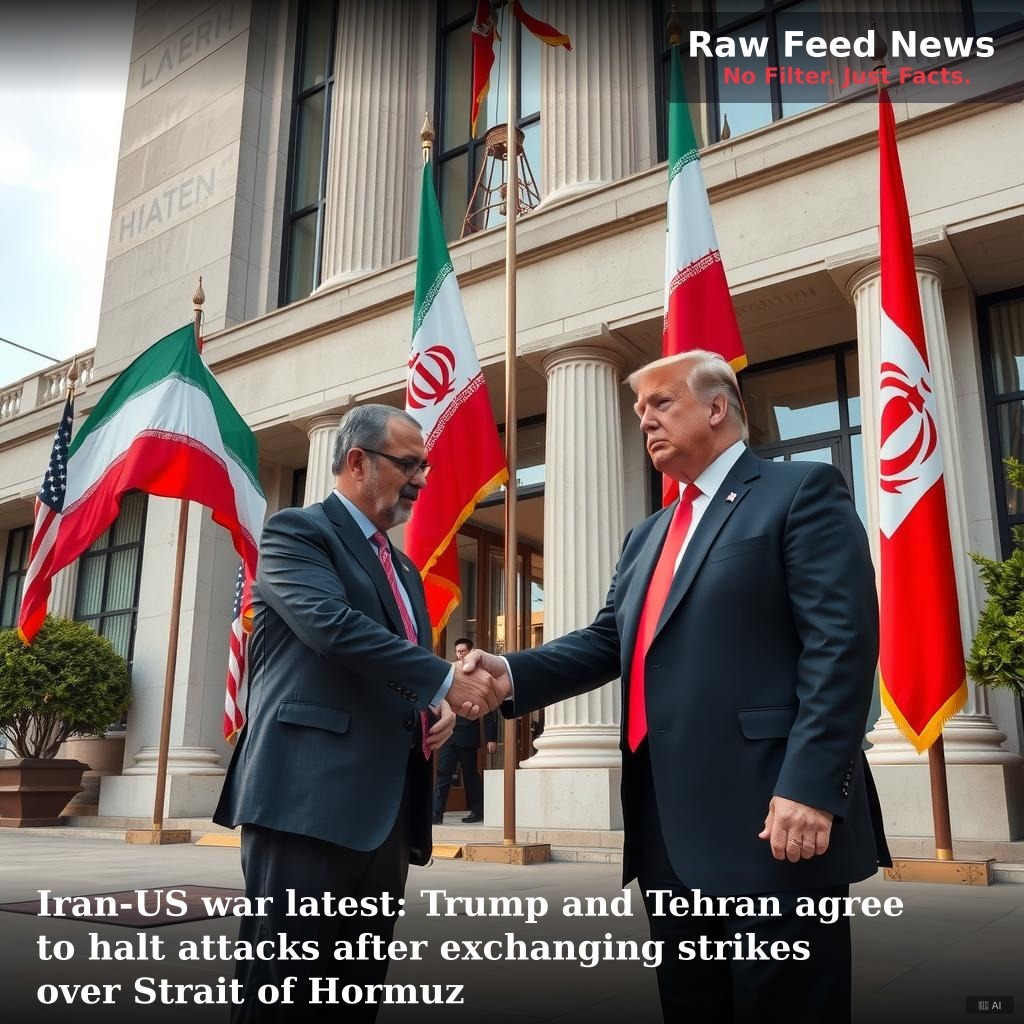
Iran-US war latest: Trump and Tehran agree to halt attacks after exchanging strikes over Strait of Hormuz
Iran and the United States have reportedly agreed to halt recent strikes and renew talks regarding their dispute over the Strait of Hormuz. The development, reported by Axios, could end hostilities that had threatened an interim peace agreement. The two sides plan to meet Tuesday in Qatar, Axios said, citing a senior US official. Iran and the US had traded attacks in the Gulf in recent days as each accused the other of violating an interim deal signed less than two weeks ago to end their four month war. On Sunday, Iran said its naval and aerospace forces carried out a joint missile and drone operation targeting US military sites in Kuwait and Bahrain, and warned further violations would receive a “crushing response”. Earlier, the US military said it had struck Iran for the second day after a tanker was hit in the Strait of Hormuz. US Central Command said its strikes were launched “in direct response to continued Iranian aggression against commercial shipping". Iran and Oman hold first meeting of joint Strait of Hormuz committee Iran and Oman have held the first meeting of a joint committee on the Strait of Hormuz in Muscat, an Iranian deputy foreign minister said on his X account on Monday. Kazem Gharibabadi said they had exchanged views on Gulf coastal states' sovereign rights and on future management of the strait. “While reviewing current issues related to the Strait, we exchanged views on the future management of the Strait within the framework of paragraph five of the Islamabad Memorandum of Understanding and the sovereign rights of the coastal states,” he wrote. Alex Croft29 June 2026 07:54How violence has followed a much-anticipated peace deal One round of mediated talks, led by vice president JD Vance and Iran's parliamentary speaker, Mohammad Baqer Qalibaf, was held in Switzerland a week ago and Washington waived sanctions on Tehran. But fighting has since resumed and intensified. In a Truth Social post, Donald Trump said on Sunday: "There may come a point when we are no longer able to be reasonable, and will be forced to militarily complete the job that we very successfully started.” About an hour after Trump's post, Kuwait's army said its air defenses were responding to missile and drone attacks, while Bahrain said sirens had sounded there. Iran's Islamic Revolutionary Guard Corps said in a statement its navy and air forces had launched missile and drone operations targeting US military sites in Kuwait and Bahrain. The Guards said US strikes had violated the ceasefire and "will result in the complete halt of all diplomatic processes", state-run Press TV said. The IRGC navy command said American bases in the region "will experience hell in the coming days". Hours later, alarms sounded for a second time in Bahrain, where authorities said an Iranian attack damaged a residential building in Muharraq province, with no casualties reported. The Kuwaiti army said it had intercepted two ballistic missiles with no damage or casualties. Separately, Qatar said one of its nationals had died after sustaining injuries from shrapnel aboard a vessel that had gone missing on Saturday. A second person was injured in the incident. Alex Croft29 June 2026 07:32‘Trump wasn’t victorious – it was a major defeat’: protestors inside Iran speak out The signing of a memorandum of understanding between US president Donald Trump and Iranian president Masoud Pezeshkian was seen by many Iranians not as the end of a crisis, as portrayed by Washington and Tehran, but as a symbol of “political betrayal” and “America’s historic failure”. In messages sent to Independent Persian, readers from various cities across Iran said that after 39 days of war, Trump ultimately agreed to a deal with the Islamic Republic while the core power structure in Tehran remains intact, the influence of the Islamic Revolutionary Guard Corps (IRGC) has grown, and ordinary Iranians have been left to cope with economic hardship, destroyed homes, unemployment and a new wave of executions. Their anger is directed above all at the gap between the rhetoric that accompanied the start of the war and its eventual outcome.