China hopes Indo-Pacific nations do not ‘overinterpret’ rare missile test in nuclear-free zone
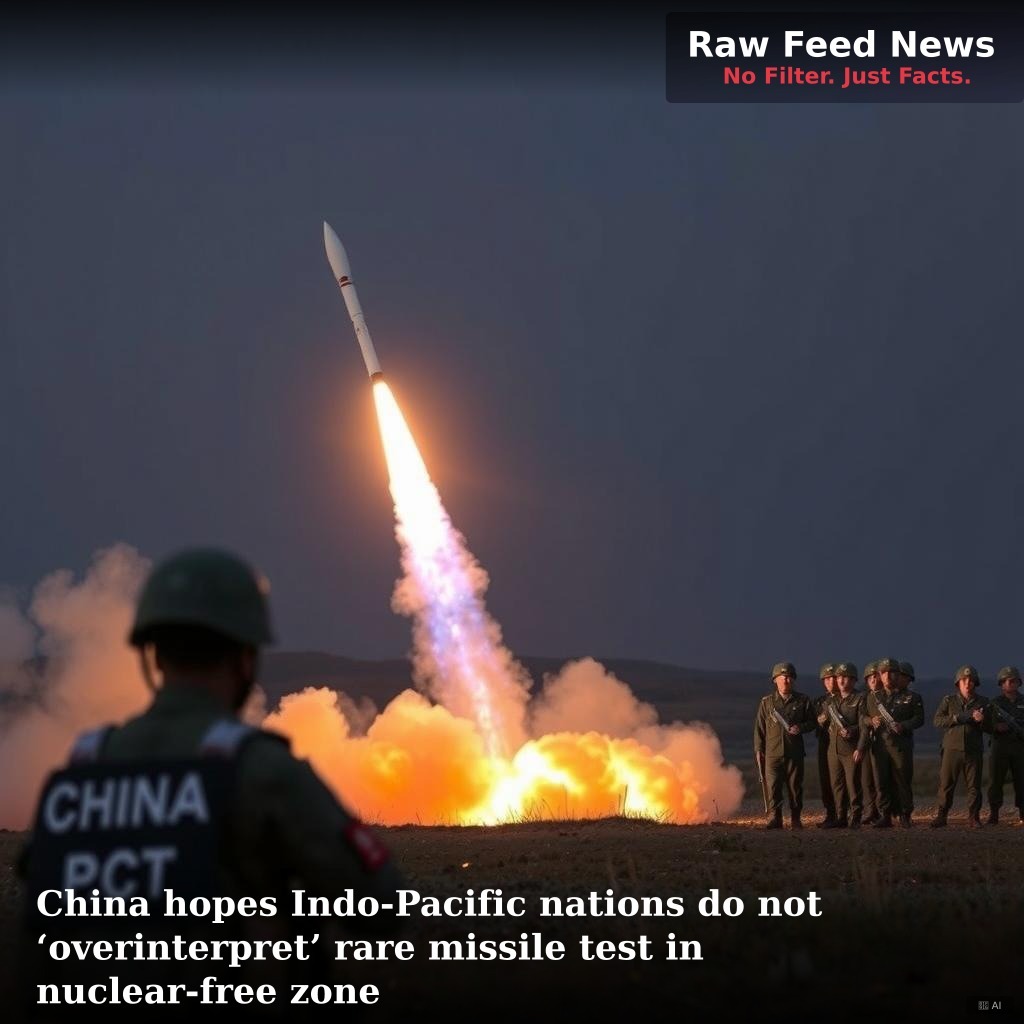
China on Monday urged Indo-Pacific nations to “not overinterpret” its test of a long-range ballistic missile from a nuclear-powered submarine, a rare launch that triggered alarm across the region. Australia, New Zealand, Japan, and Papua New Guinea immediately criticised China for the test. The missile was launched at 12.01pm on Monday, carrying a dummy warhead, the Chinese navy said in a statement. A submarine “launched a strategic missile carrying a dummy warhead towards relevant high seas of the Pacific Ocean, which landed precisely within the designated waters,” Senior Captain Wang Xuemeng, a spokesperson for the navy, said. “This test launch was a routine part of China’s annual military training schedule,” he added, noting that “relevant nations” had been informed in advance. “The operation was in accordance with international law and practice, targeting no specific country or objective.” The missile test was China’s first such in the Pacific Ocean in two years. The submarine-launched JL-3 intercontinental ballistic missile is seen during a military parade marking the 80th anniversary of China's victory over Japan in World War II in Beijing on 3 September 2025 (AFP/Getty) The Chinese navy operates two types of submarine-launched ballistic missiles. The JL-2 is estimated to range 7,000-8,000 km and the JL-3 more than 10,000km, allowing China to target much of continental US from waters closer to home. The Chinese foreign ministry said the test was part of "routine" military training and was "not directed at any specific country or target". "The related launch activity was conducted in a safe, regulated, and professional manner, and we hope that certain countries will refrain from overinterpreting them," the ministry’s spokesperson, Mao Ning, said. Even though Australia, New Zealand and Japan were informed before the launch, Tokyo complained that the test was conducted within 90 minutes of the notice arriving. The Japanese government said it "strongly urged" China to reconsider the move. "We expressed our grave concern over the Chinese military's increased activity," it said, adding that Chinese authorities had notified the Japanese coast guard on Sunday about space debris that could fall within its exclusive economic zone. New Zealand’s government said the missile landed within the South Pacific Nuclear Free Zone established by the 1986 Treaty of Rarotonga. The treaty prohibits nuclear weapons in the region. China ratified the protocols in 1987 pledging not to test nuclear weapons within the zone, or threaten to use them against the signatories of the treaty with territory in the region. "It appears that despite our long-standing concerns about this type of activity, China carried out the test within hours of informing us,” New Zealand’s foreign minister Winston Peters said. "New Zealand considers this an unwelcome and concerning development. We, like our neighbours in other Pacific countries, have no interest in China using the South Pacific as a testing site for missile capability," he added. Anthony Albanese with Fiji's prime minister Sitiveni Rabuka, right, at the Australian high commissioner’s residence in Suva on 6 July 2026 (AFP/Getty) Australia's foreign minister Penny Wong told reporters in Suva that the test was "in the context of a rapid military build-up by China" and that it threatened "destabilising" the region. The test came as Australian prime minister Anthony Albanese was visiting Fiji to sign a mutual defence treaty, widely seen as an effort to counter Chinese influence in the Pacific. The agreement is Fiji's first alliance of its kind and Australia's fourth, following similar agreements with the US, New Zealand, and Papua New Guinea. Mr Albanese described the treaty as "one of the most significant endeavours" Australia had undertaken with any country. Fiji’s prime minister, Sitiveni Rabuka, called it a “defining moment" in the bilateral relationship and said that it marked a "very significant elevation of our bilateral relationship". The deal will be backed by more than A$1bn ($650m) in Australian government funding over the next decade for measures to combat transnational crime as well as for health and infrastructure projects in Fiji, according to Mr Albanese. Anthony Albanese and Fiji’s public works minister Ro Filipe Tuisawau cut a cake during the opening of the Vuvale Skills hub in Suva (AFP/Getty) Mark Douglas, an analyst at the ship-tracking firm Starboard Maritime Intelligence in New Zealand, said that the missile test had been planned long in advance but noted the timing of China's notification – after Australia and Fiji signed the Ocean of Peace Alliance – was "interesting, to say the least”. Asked whether he expected any backlash from Beijing, Mr Rabuka said he believed China would "welcome the understanding". "It does not threaten Fiji's relationship with China nor Australia's relationship with China," he said, according to Australian broadcaster ABC. China maintains a “no first use” of nuclear weapons policy, but is actively pursuing nuclear technology and weaponry as part of its long-term strategy to modernise the military. China boasts a fleet of six ballistic-missile submarines and 59 nuclear-powered attack submarines, according to the Nuclear Threat Initiative, a Washington-based think tank.