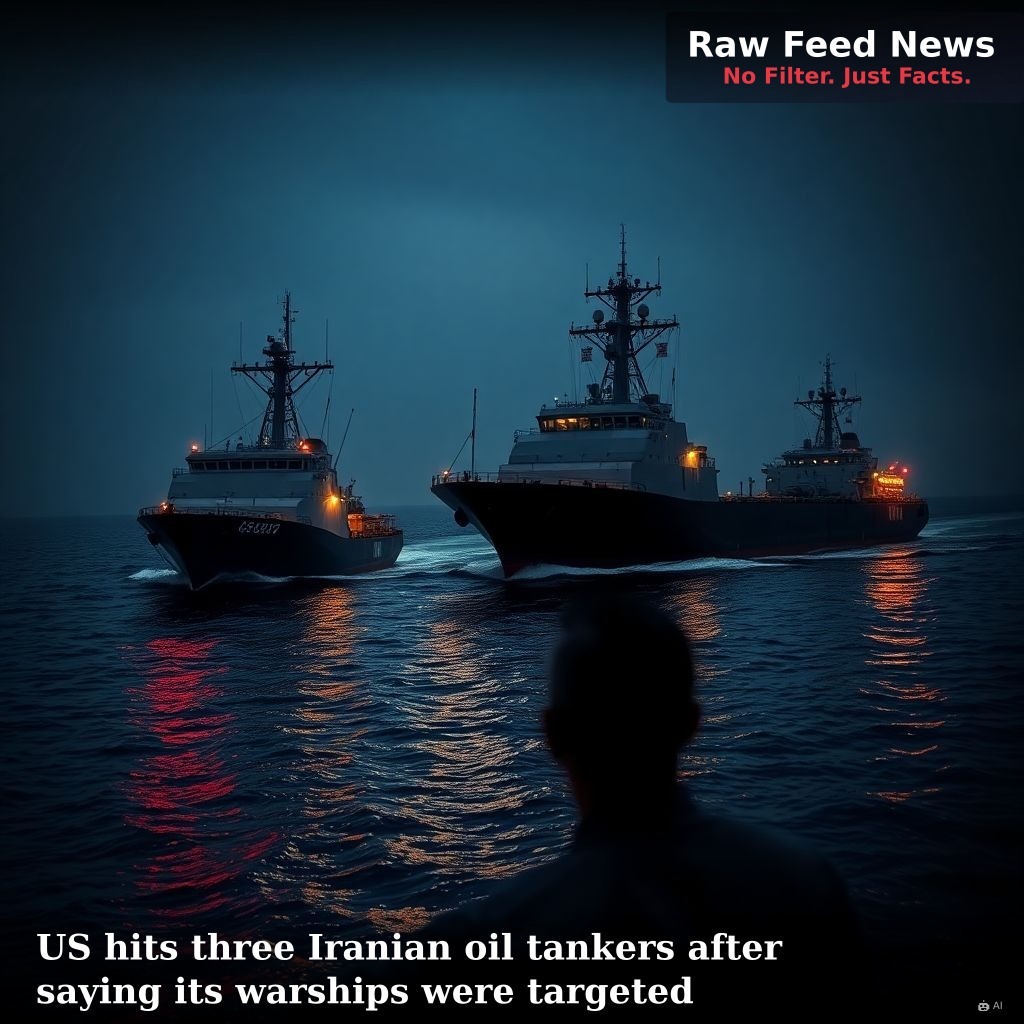
US hits three Iranian oil tankers after saying its warships were targeted
The US military says it has hit three Iranian oil tankers after Iran launched ballistic missiles towards two American Navy warships in the region. US Central Command (Centcom) said on Saturday it had "permanently disabled" a tanker near Kharg Island and another near Jask in the Gulf of Oman, and "completely destroyed" a third in the Gulf of Oman. Centcom said it "successfully evaded" multiple attacks from the Islamic Revolutionary Guard Corps (IRGC) targeting a US aircraft carrier and guided-missile destroyer. No American troops were harmed, it said. Iranian state media reported that US forces struck three of its oil tankers, including one near Kharg Island. Kharg Island is a small rocky outcrop just 15 nautical miles (24km) off the coast of Iran. Ninety percent of Iran's crude oil comes through a terminal on the island - transported through pipes from the mainland. Iranian state media outlet IRIB reported that there were no casualties in the attack on the tanker near Kharg Island, and that footage indicates the vessel's cooling system put out the fire within an hour. The crews aboard the two attacked tankers in the Gulf of Oman were taken to shore in lifeboats, IRIB reported. One of those tankers was empty and the other was carrying a load of oil, it added. Tehran did not immediately acknowledge Iranian attacks on US ships. Admiral Brad Cooper, Centcom's commander, said in a statement on Saturday: "Let the message to the IRGC be clear: If you shoot at two of our ships, we will impose an even higher economic cost - taking out three of yours." "We will not hesitate to defend American forces, and if necessary, destroy Iran's limited and exposed oil fleet." Centcom, which oversees US military operations in the Middle East, claimed that the three Iranian oil tankers were "part of a multi-billion-dollar shadow network that funds the IRGC and its regional proxies". The strikes come nearly a week after renewed attacks between the US and Iran, which followed a period of relative calm between the warring sides. The US resumed attacks on Sunday, when it said it had struck two rocket launchers to prevent them being used to lay naval mines in the Strait of Hormuz. A 60-day ceasefire between the US and Iran formally expired last month, with little sign of a further diplomatic settlement on the horizon. Days after the ceasefire expired, Trump said the US would launch tougher economic measures against Iran, as well as any country that helps or does business with it. The US and Israel first launched wide-ranging strikes on Iran on 28 February, with Iran responding by attacking Israel, US bases and allied states in the Gulf, and effectively closing the Strait of Hormuz to marine traffic. The Strait of Hormuz previously served as one of the busiest oil-shipping routes, carrying about 20% of the world's oil and LNG supplies. Currently, the strait has become a major point of conflict between Iran and the United States, with Iran seeking greater control over the waterway and threatening a crucial global trade route. The conflict in the strait has raised energy prices globally. And, ahead of the US midterm elections in November, Trump is facing pressure over how much the war is costing American consumers. On Friday, the average price for one gallon of diesel in the US hit $5.85, compared to an average of $3.71 a year ago and above the previous high following Russia's full-scale invasion of Ukraine, according to the American Automobile Association (AAA).