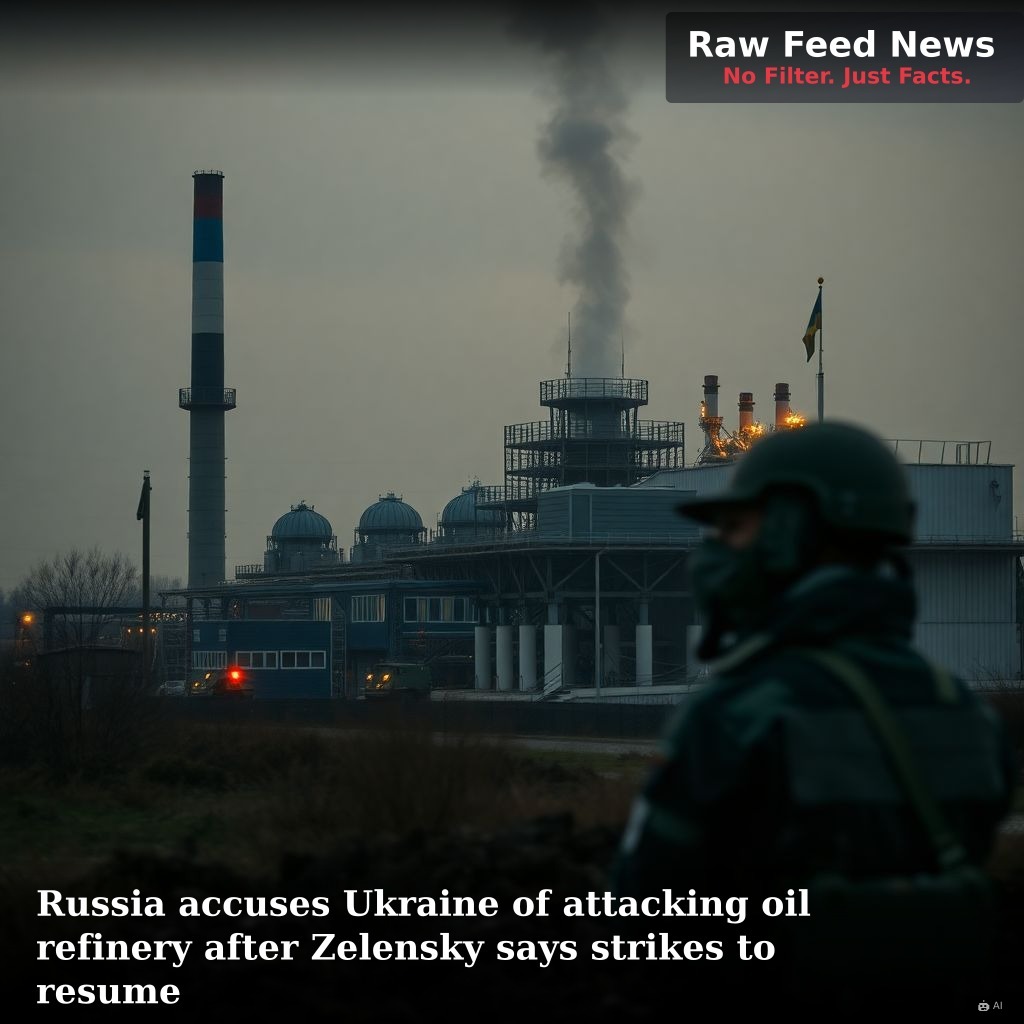
Russia accuses Ukraine of attacking oil refinery after Zelensky says strikes to resume
Russia has accused Ukraine of attacking an oil refinery after Volodymyr Zelensky said such strikes, halted at the request of the US, would resume. Ukraine's president said he had restricted attacks for three days while Russia had continued striking Ukrainian energy infrastructure. "We're done," he told the Financial Times, external. Zelensky also accused the US of withdrawing intelligence-sharing on Russian strikes to pressure Kyiv into ending attacks altogether after it struck a deal to import Russian diesel, and he said curbs on Starlink satellite services used by Ukraine's military were deliberate. Ukrainian defence sources told the BBC some Starlink functionality had resumed as of Thursday morning. They said its military service Starshield's "operation while on the move" had been restored, although it remains unclear whether the restrictions to the speed at which drones could fly while still maintaining Starlink internet connection have been fully lifted. Officials were still working to clarify "the reasons and circumstances" behind the move, the sources added. In a separate development, seven people are missing after a drone attack set a chemical tanker on fire off Romania, according to naval officials. Moscow said it had hit two cargo ships with military cargo heading to Ukraine's Odesa port, without naming them. The Kremlin said Kyiv had "attempted a large-scale attack" on a refinery south of Moscow early on Thursday. According to Russia's defence ministry, four missiles and dozens of drones were intercepted and the falling debris caused a fire at the site in Ryazan. Zelensky said dozens of Ukrainian cities had come under Russian attack in the past day. He previously said he would agree to the "energy ceasefire" announced by US President Donald Trump on Sunday if Moscow also abided by it. But he accused Russia of ignoring the proposed deal within hours of it being announced, with strikes leaving hundreds of thousands of Ukrainians without power. The Kremlin never said it had agreed to the deal. Zelensky agreed that he felt betrayed by the US when asked by Piers Morgan on Wednesday night, after Washington appeared to withdraw key elements of its support. European leaders have rallied around the Ukrainian president. Italy's Defence Minister Guido Crosetto told the BBC that the US restricting its intelligence-sharing with Kyiv would be a "complete mistake". "Because it is a fundamental form of support. This means denying a country any chance of defending itself." He added: "Peace will be achieved when [Russian President Vladimir] Putin will be convinced that there is a stalemate... that he cannot advance anymore. But if he sees a weakness on the Ukrainian front, if the United States takes its resources away, then Putin will think he can win, and so he will continue the war." Zelensky told the FT that Ukrainian officials had been told by US counterparts that "if you will not stop [the strikes], we will block intelligence". Ukraine's military relies on US early-warning alerts of incoming Russian aerial attacks to mount air defences, limiting successful strikes, while Starlink internet links are used throughout its war effort to guide drones and protect its skies. There were suggestions a technical glitch was to blame for the sudden Starlink restrictions on Tuesday evening, but owner Elon Musk appeared to deny this and suggested it was the Trump administration's doing. "It was not a technical problem, it was the will," Zelensky told the FT. Trump has denied halting intelligence-sharing. Starlink's sister service Starshield is provided to Ukraine under a US defence department contract. The BBC has approached the US authorities for comment. Zelensky spoke to the FT during a visit to London on Wednesday which also included a meeting with Prime Minister Andy Burnham in Downing Street - who announced the UK would speed up delivery of lightweight multirole missiles to Kyiv. The Ukrainian president told the FT he would now only halt strikes on Russian oil infrastructure - which Kyiv says are vital to cutting off revenue streams to its war machine - if the US supplied more Patriot air defence missiles. Ukraine has suffered a shortage of the US-made defences since the outbreak of the Iran war consumed stockpiles. Striking a more defiant tone than recently, the Ukrainian president told the newspaper his American counterpart had an affinity for autocratic leaders like Putin. He said it was not up to him to mend US-Ukrainian relations given the events of the past week: "We didn't destroy any relationship." Tensions have previously frayed between the two leaders. After returning to the White House last year, the pair shared a fiery Oval Office meeting in which Trump implied Zelensky was the main block to a peace deal. Zelensky has since walked a careful diplomatic line, showing willingness towards US-brokered deals while stressing that the terms of any peace deal must be just. But he criticised the agreement between Russia and the US to release 300,000 tonnes of diesel to the US and global marketplace, struck last week, as the US effectively investing in Russia's war effort. That deal was the latest effort by Trump to lower fuel prices in the US ahead of the midterm elections, after months spent grappling with the political consequences of the Iran war. That conflict has sent the cost of petrol - and in particular diesel - skyrocketing, souring his standing with the American public. Zelensky told the FT: "The question will be: when will the next deal be? Maybe it will be gas. Definitely it will be gas." With Russia continuing to strike Ukraine, Zelensky suggested the disruptions to US support was no coincidence.